Why Did the Plane Come In Sideways? A Pilot Explains Crosswind Landings
Why Did the Plane Come In Sideways? A Pilot Explains Crosswind Landings
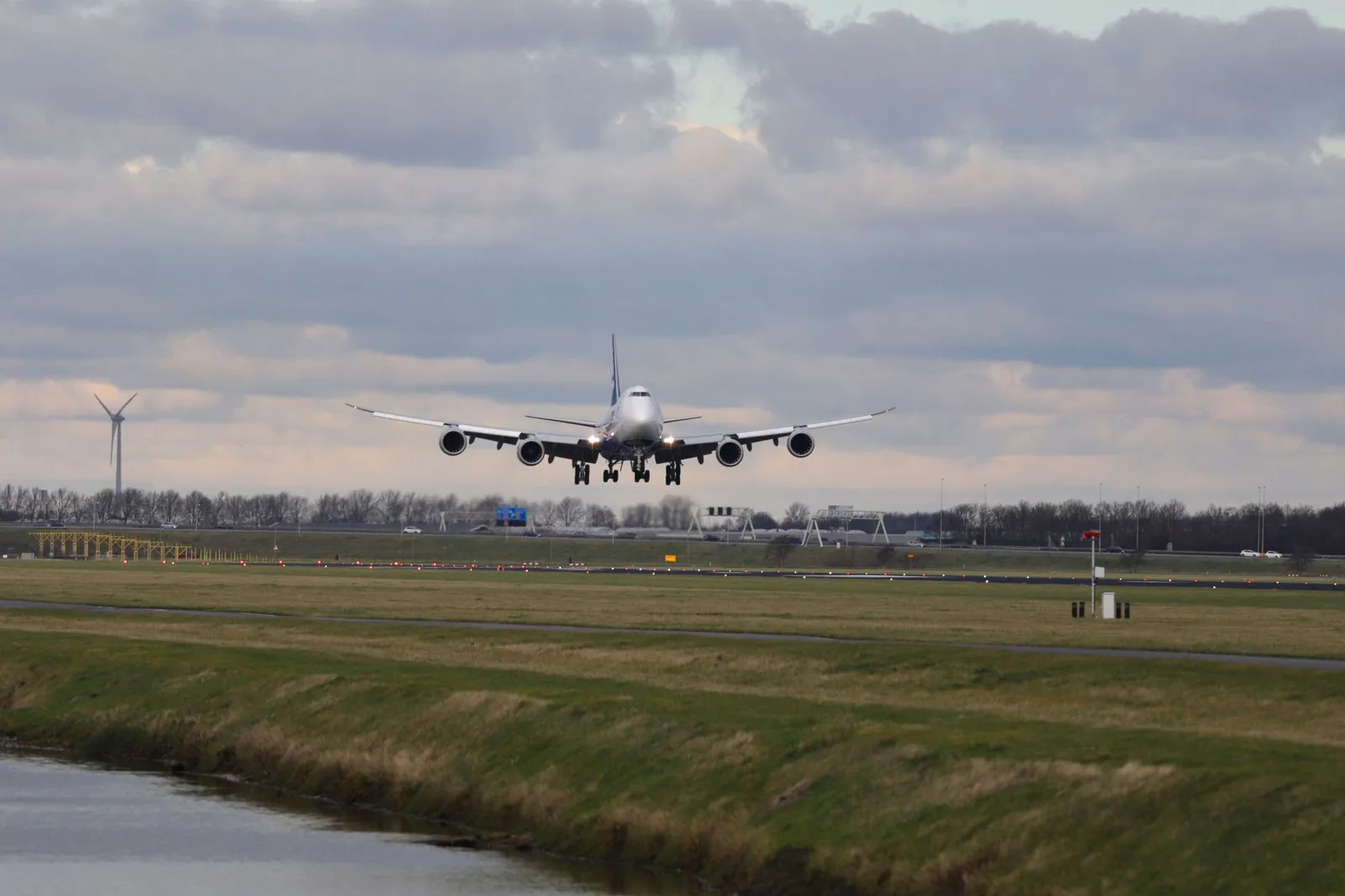
A plane that approaches the runway at an angle is not out of control: it is pointing slightly into the wind so that its path over the ground stays exactly on the runway centerline. This is called a crab, and it is the standard technique for a crosswind landing. A few seconds before touchdown the pilot swings the nose back in line with the runway, which is the sudden yaw you feel in your seat. Every airliner has a tested crosswind limit, every airline sets its own rules on top of it, and when the wind is outside those numbers the crew simply does not land there.
Why was the plane pointing sideways on final approach?
Because the wind was blowing across the runway, and pointing the nose partly into it is how the pilot keeps the aircraft on the centerline. An airplane moves with the air mass it flies in. If that air is sliding sideways at 25 knots, the aircraft slides with it, unless the pilot aims it a little upwind.
Think of swimming across a river with a current. To reach the point straight in front of you, you swim at an angle, facing slightly upstream. Your body points one way, your path goes another. From the riverbank it looks odd. From the water it is the only sensible way to do it.
That is exactly what you saw from your window: the runway lights off to one side, the nose aimed at the grass, the whole thing looking crooked. The FAA teaches this crab method from the first flying lessons, and it is described step by step in the FAA's Airplane Flying Handbook. In an airliner it is the same idea, flown with more precision and more automation to help.
Is a crosswind landing dangerous?
No, a crosswind landing inside the published limits is a normal landing. Almost every landing has some crosswind, because the wind almost never blows perfectly along the runway. Most of the time it is so light you never notice it. On a windy autumn day it becomes visible, and that is the only real difference.
Runways themselves are built around wind. Airports orient them along the prevailing winds, and big airports often have runways in several directions so that at least one is close to the wind. We explain that logic in why planes take off and land into the wind. What is left over, the part of the wind that blows across, is what the crew handles with the crab.
The honest version is this: strong crosswind is one of the conditions that makes a landing more demanding for the pilot. That is precisely why it is so heavily framed by limits, briefings and training. Demanding for the crew does not mean dangerous for you. It means the two people in front are working harder for about a minute, with a procedure they know by heart.
Is there a wind limit above which pilots will not land?
Yes, and there are actually several layers of limits, each one more conservative than the last. The first is the maximum demonstrated crosswind, a figure established by test pilots during certification of the aircraft. For most current airliners it sits somewhere in the 30 to 40 knot range across the runway, roughly 55 to 75 km/h. That figure is not the point where the aircraft stops being controllable. It is simply the strongest crosswind that was actually flown and validated during testing.
On top of that, each airline writes its own limits in its operations manual, often lower than the demonstrated figure. The limits drop further when the runway is wet or contaminated. In its flight operations briefing note on crosswind landings, Airbus publishes a table where the recommended maximum shrinks step by step as braking conditions get worse, down to single figures on a runway at high risk of hydroplaning. The same document notes that some operators apply lower limits when the first officer is flying or when a captain is new on type. Automatic landings have their own, tighter limit.
In practice this means the decision is made long before the runway is in sight. The crew gets the wind from the airport weather broadcast twenty minutes out, and again from the tower with the landing clearance. If the numbers do not fit, there is no debate in the cockpit. The runway is off the table.
What does the pilot actually do in the last few seconds?
In the final seconds the pilot straightens the aircraft with the rudder pedals and holds it straight with a little wing down into the wind. Airbus recommends flying the approach wings level with the crab angle, then removing that angle during the flare, the gentle raise of the nose just before touchdown.
Here is what it feels like from the flight deck. Around fifty feet above the runway, the pilot pushes on the rudder pedal on the downwind side. The nose swings round to line up with the runway. Without anything else the wind would now start pushing the aircraft sideways, so the pilot adds a small bank into the wind with the control column or sidestick to stop the drift. The aircraft touches down on the upwind main wheels first, then the other side, then the nose wheel.
In very strong crosswinds the technique allows a small amount of crab to remain at touchdown, a few degrees at most, rather than asking for a large bank close to the ground. The landing gear is designed to accept that sideways load. What looks from the cabin like the pilot fighting the aircraft is a sequence of small, deliberate inputs that every airline pilot practices in the simulator at least twice a year, including in winds far stronger than you will ever land in on a normal flight.
Why did the touchdown feel so hard and crooked?
Because on a windy day a firm touchdown is the correct touchdown, and one wheel landing before the other is part of the technique. A soft, floating landing in gusty wind means the aircraft stays airborne longer, drifts, and uses up runway. Pilots are trained to put the aircraft on the ground at the planned point, positively, especially if the runway is wet. The thump you felt was intended.
The crookedness has the same origin. You felt the yaw when the nose swung straight, then the roll as the upwind wing dipped, then the first wheel touching. Three movements in three seconds, none of them in the gentle rhythm your body expects from a landing. Add gusts that make the aircraft rise and sink a little on final, and your nervous system reads all of it as loss of control.
It is worth knowing that the sensations are much stronger at the back of the cabin and near the windows, where the yaw is most visible. None of that corresponds to what the instruments show in the cockpit: a stable speed, a stable path, a centerline that the aircraft is tracking.
What happens if the wind is too strong on the day?
If the wind is outside the limits, the crew uses another runway, waits in a holding pattern for a gust to pass, or diverts to another airport. Nobody tries a landing that does not fit the numbers. Every flight carries fuel for the destination, for a named alternate airport and for a reserve on top, precisely so that this choice is always available.
If the wind changes during the approach itself, the answer is the go-around: full thrust, climb away, try again or go elsewhere. It feels abrupt, and it is the most rehearsed maneuver in the job. We have described it in detail in why the plane climbed away instead of landing.
So on a stormy evening, the realistic worst case for you as a passenger is not a dramatic landing. It is a delay, a second approach, or a night in a different city from the one on your ticket. Frustrating, yes. Dangerous, no.
Why do crosswind landings seem more common in autumn?
Because autumn and winter bring stronger, more frequent Atlantic storms to Europe and to much of North America. The main reason is the jet stream, a band of very fast wind high in the atmosphere. As the Met Office explains, the temperature contrast between the poles and the tropics grows as the season turns, which strengthens the jet stream and helps deepen the low pressure systems that bring wind and rain.
Down at runway level, that translates into windy, gusty days where the wind rarely lines up with the runway. From October onward, crews at coastal and northern European airports fly many more visible crosswind landings than in July. If you fly this time of year, the odds that you will see one are simply higher, and that tells you about the season, not about the safety of your flight.
How can I get through a windy approach as a passenger?
The most useful thing you can do is know the sequence in advance, so that each movement arrives as expected instead of as a threat. On a windy approach, you will feel some rising and sinking in the gusts, you may see the runway off to the side, then feel a swing of the nose, a slight tilt, and a firm touchdown. If you can name each step as it happens, your body has less room to invent a disaster.
During the last few minutes, slow your breathing down, with a longer breath out than in. Put your feet flat on the floor and let the seat take your weight instead of bracing against it. Tensing every muscle does not help the aircraft land and makes every bump feel bigger. If a window seat makes things worse on windy days, choose an aisle seat over the wing where the motion is smallest.
And if the approach is always the moment you dread, it usually says more about how your fear works than about the weather. Our guide on how to overcome the fear of flying explains where that loop comes from and how people actually get out of it.
What do anxious flyers ask most about crosswind landings?
Can a strong gust flip the plane over on landing?
No. An airliner weighs dozens or hundreds of tons and flies at around 140 knots on final approach. Gusts make it rise, sink and roll a few degrees, which the pilot corrects continuously. The limits are set well below anything that would threaten control of the aircraft.
Does the autopilot land the plane in a crosswind?
Usually not. Most crosswind landings are flown by hand, and automatic landings have their own, lower crosswind limit. Pilots train manual crosswind landings in the simulator on a regular basis for this reason.
Why did the pilot not warn us it would be windy?
Many do, especially when the approach will be bumpy. When they do not, it is often because the crew is busy with the approach briefing and the weather is within normal operating conditions for them. A windy landing is ordinary enough on the flight deck that it does not always feel worth an announcement.
Is it safer to fly on a less windy day?
Your flight is equally safe either way, because the crew will not land outside the limits. A calmer day simply means a smoother ride and fewer chances of delay or diversion. If comfort matters to you, morning flights are often calmer, but safety is not what changes.
Are small planes worse in a crosswind?
Smaller aircraft have lower crosswind limits and are moved more by gusts, so a windy landing in a regional aircraft can feel livelier. Their crews apply the same principle: if the wind is above the limit for that type, they do not land there.
What if the landing is the part you dread most?
Understanding a crosswind landing helps, and it rarely dissolves a fear on its own. If your heart rate climbs the moment the wheels come down, the useful work is learning what your body is doing and how to interrupt it. We do not have a magic wand, but we do have a method.
You can start with our free fear of flying assessment. It takes a few minutes and gives you a clear read on what is actually driving your fear. If you want to go further, our online fear of flying course was built by airline pilots and psychologists, and you follow it at your own pace.
No pressure and no deadline. The door is open whenever you decide it is time.