Why Do Airplane Wings Bend So Much? A Pilot Explains
Why Do Airplane Wings Bend So Much? A Pilot Explains
Airplane wings bend because they are built to bend, and the movement you see from your window is the structure doing exactly what it was designed to do. Before an aircraft is certified, one wing is loaded on the ground until it snaps, at more than 150 percent of the worst load the aircraft will ever meet in service. A modern wing tip can travel several meters between rest and that breaking point. A rigid wing would be the dangerous one, because it would pass every gust straight into the airframe instead of absorbing it. Pilots do not watch the wings, they watch the instruments, and the wing is the part of the aircraft they think about least.
What you are actually looking at from seat 24A
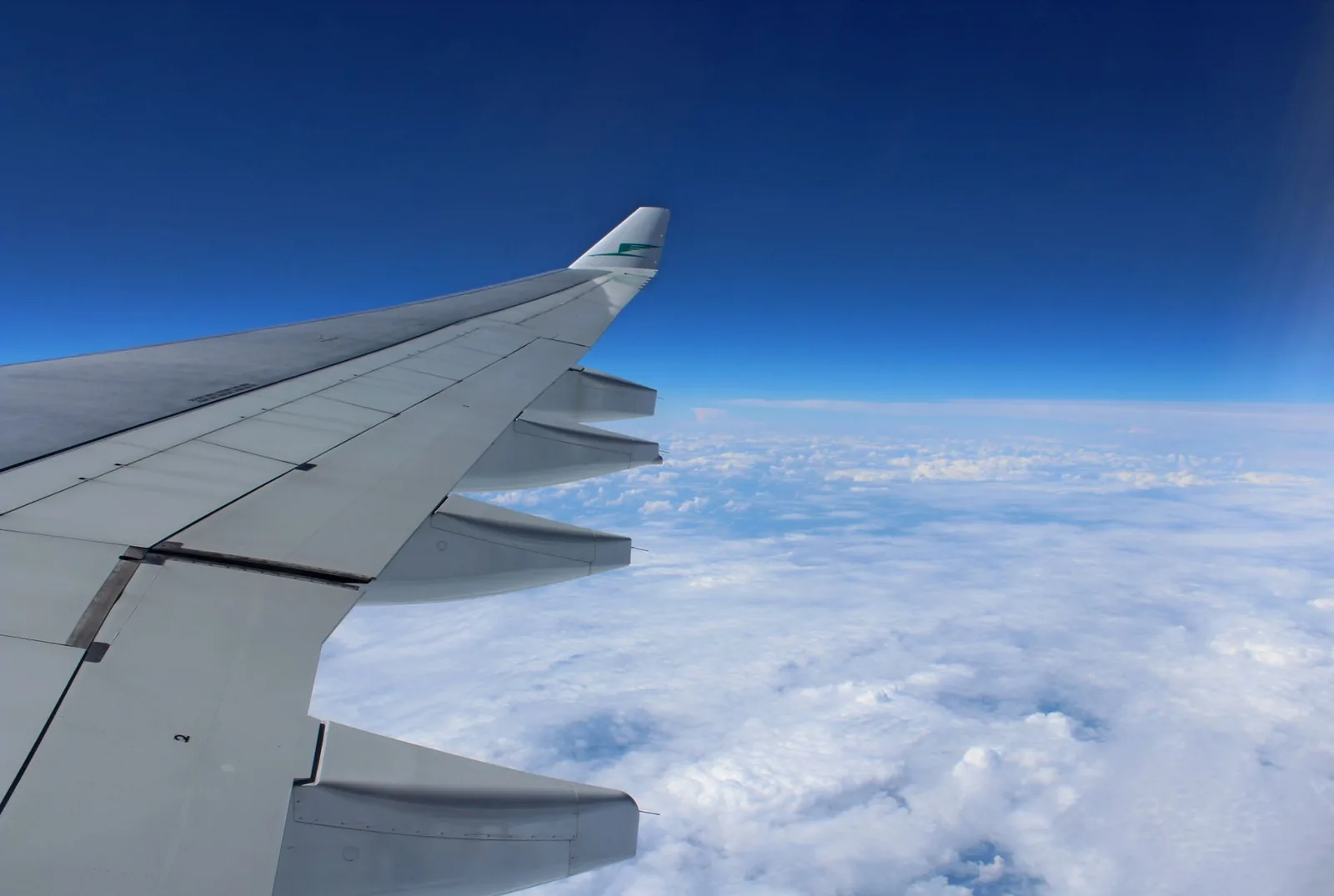
Sit over the wing on a clear day and you will see two different movements. The first is slow: the tip rises as the aircraft lifts off and stays up through the whole flight. The second is fast: small vertical oscillations of a few centimeters as the aircraft crosses uneven air.
Both are normal, and the numbers are smaller than they feel. On a typical narrow body airliner, the wing tip rises roughly one meter between standing at the gate and climbing away at full thrust. In cruise, in light chop, tip movement is usually a matter of centimeters. What makes it look dramatic is perspective: you are sitting a few meters from a structure that is thirty meters long, so a small angle at the root becomes a visible sweep at the tip.
One more thing changes what you see. On the ground with full tanks, the wings sag, because the fuel is heavy and there is no lift holding the wing up. That sag is not damage. It is the same flexibility, working in the other direction.
Why a wing has to bend
Most passengers picture the wings as attached to the aircraft. It is more accurate the other way around: in flight, the aircraft hangs from the wings. Lift is generated along the whole span, while the weight (fuselage, cabin, engines, landing gear, you) is concentrated in the middle. That combination bends the wing upward, exactly like holding a ruler at both ends and pushing up in the middle.
So the wing has to bend. The engineering question is not whether it moves, it is how the structure handles the load while it moves. The answer is a pair of spars running the length of the wing, connected by ribs and covered by a skin that carries part of the load. Together they behave like a spring: firm, but not brittle.
There is a detail pilots find reassuring and passengers rarely hear. Most of the fuel sits inside the wings, and that fuel weight pulls the wing down while lift pulls it up. The two partly cancel out. This is called bending relief, and it means a wing full of fuel is under less bending stress than an empty one. The heavy long haul flight you are dreading is, in this specific respect, gentler on the structure than the short hop.
The test that ends with a broken wing
Certification does not rely on calculation alone. Under the European and American rules for large aircraft, the manufacturer defines the limit load, which is the highest load the aircraft is expected to meet in service. For an airliner that corresponds to about 2.5g positive and 1g negative. The structure must then survive the ultimate load, which is the limit load multiplied by 1.5, for at least three seconds without failing.
To prove it, one complete airframe is sacrificed. It is clamped in a steel rig, hydraulic jacks pull the wings upward, and the load keeps rising past 100 percent, past 150 percent, until something breaks.
The results are public. When Boeing ran the test on the original 777 in 1995, the wings failed at 154 percent of limit load, with the tips deflected about 7 meters (24 feet) above their rest position. The 787 passed the same milestone with its composite wings flexed roughly 7.5 meters upward. On the A380, the wing broke at close to 1.45 to 1.50 times limit load, which is what the models had predicted. Aerospace media covered these tests in detail: how aircraft wings are built to bend explains why a small overshoot of the target is considered a good result rather than a lucky one.
Read that again, because it is the fact that matters. The wing does not break at the loads of a bad flight. It breaks at more than one and a half times the worst load the aircraft is ever expected to see, and no airliner has ever come close to that in normal operation.
How far can a wing actually bend?
Test figures and flight figures are two different things, and mixing them up is what fuels the fear.
In testing, an A350 wing has been flexed by more than 5 meters at the tip, and a 787 wing by around 7.5 meters. Those are laboratory numbers, reached with hydraulic jacks at loads no passenger will experience. In service, tip movement stays a small fraction of that: a meter or so during a firm rotation on takeoff, and centimeters in the bumps you actually feel in the cabin. General interest coverage of why wings bend and how far they can go makes the same point: the visible movement is well inside the design envelope, not near the edge of it.
Wing tips on the newest aircraft move more visibly than on older ones. That is a materials story, not a weakness. The 787 and the A350 are more than half composite by weight, and carbon fiber structures are lighter, more elastic and far less sensitive to fatigue than aluminum alloys. More visible flex on a new aircraft means a newer wing, not a tired one.
Flex is what makes turbulence bearable
Turbulence is a series of pressure changes hitting the wing. A flexible wing turns a sharp input into a slower, softer one: it absorbs part of the energy, spreads the peak over time, and passes on less of it to the cabin. This is why a stiff wing would be worse for you, not better. You would feel every gust as a single hard jolt.
It also explains why turbulence never threatens the structure. Even severe turbulence rarely produces more than about 0.5g of variation, against a certified margin of 2.5g and an ultimate load of 3.75g. If you want the categories and what each one actually does to the aircraft, we covered them here: turbulence on a plane, categories and consequences.
The atmosphere itself is changing, and that is worth stating plainly rather than hiding. Research on jet streams suggests clear air turbulence is becoming more frequent on some routes, as Scientific American reported on why flights are getting bumpier. More bumps means more discomfort and a stronger case for keeping your seat belt fastened. It does not move the structural numbers, which sit an order of magnitude away.
Does all that bending wear the wing out?
This is the intelligent follow up question, and the industry answered it decades ago with a second sacrificed airframe.
Alongside the static test that breaks the wing, manufacturers run a full scale fatigue test. A complete airframe is cycled through simulated flights, pressurization, taxi, takeoff, gusts, landing, again and again, typically for two to three times the design service life of the aircraft. For the A320 family, the programme simulated on the order of 120,000 flights. No safety relevant damage is allowed to appear over that span.
On top of that, every aircraft in service follows a mandatory inspection programme with defined intervals and defined checks on the structure. This is also why the age of an aircraft tells you far less than people assume. A 20 year old airframe that has been maintained to programme is not a worn out one, it is a monitored one.
What a pilot would actually worry about
Here is the honest answer, and it is anticlimactic. Wing movement is not on the list. It is not a parameter we monitor, there is no cockpit indication for it, and no crew has ever changed a plan because the wing was flexing.
What we do act on is weather, fuel, aircraft systems and the state of the runway. In turbulence, the procedure is unglamorous: slow to the recommended turbulence penetration speed, put the seat belt sign on, ask air traffic control for a different level if smoother air is available, and continue. The wing is not part of the decision.
The related question people ask next is what happens if the engines stop, which is really a question about whether the wing keeps working. It does, and the article on the glide ratio of an aircraft gives you the numbers.
If the wing is what triggers your anxiety
Practical, in order of usefulness.
Choose a seat over the wing. It is closest to the aircraft centre of gravity, so it moves least, and it also gives you the most stable visual reference if you do decide to look.
Decide in advance whether you are going to watch or not. Both work. What does not work is glancing at the wing every few seconds to check on it, because checking is a safety behaviour: it briefly lowers anxiety and reliably keeps it going.
Time your flight if scheduling allows. Thermal turbulence builds through the day, which is why the first flights of the morning are often the smoothest. We looked at the data here: are morning flights really less turbulent.
And keep your seat belt fastened whenever you are seated. Not because the aircraft is at risk, but because unbelted passengers are the only people turbulence actually injures.
FAQ
Can a wing snap off in flight?
No commercial airliner has lost a wing to turbulence. The wing is tested to failure on the ground at more than 150 percent of the highest load expected in service, and the loads produced by even severe turbulence are a small fraction of that. The margin is not thin, it is roughly an order of magnitude away from what you experience in the cabin.
Why do the wings look like they are flapping?
Because you are close to a very long structure. A movement of a fraction of a degree at the wing root becomes a visible sweep 15 or 20 meters out at the tip. The absolute movement in cruise is usually a matter of centimeters.
Do newer aircraft bend more than older ones?
Yes, visibly so on the 787 and the A350. Their wings are largely carbon fiber composite, which is lighter and more elastic than aluminum, and less sensitive to fatigue. More flex on those aircraft is a sign of a newer generation of structure, not a weaker one.
Why do the wings droop when we are parked at the gate?
Because the fuel in the wing tanks is heavy and there is no lift holding the wing up. Once you are airborne, lift takes over and the wing rises. Both positions are normal, and the fuel weight in flight actually reduces the bending stress on the wing.
Should I look at the wing or close the shade?
Whichever you choose deliberately. Looking helps people who want a stable visual reference. Not looking helps people for whom the wing is the trigger. The one thing to avoid is checking repeatedly, because that pattern maintains anxiety instead of reducing it.
If the wing is still on your mind at cruise altitude
Knowing the numbers helps, but knowing is not the same as feeling calm, and that gap is the part we work on.
Start with our free questionnaire to see where your anxiety actually sits: evaluate your fear of flying. It takes three minutes and it is the fastest way to know what would help you most.
If you want to go further, the Fofly online course is built by pilots and psychologists, module by module, at your pace. The structural sessions cover exactly what you have just read, with the footage of the tests. The door is open when you want it.